
We Poison Ourselves Without Meaning To
The same careless words we aim at others, we aim at ourselves just as often. The only reason it keeps happening is that almost nobody actually knows what they're speaking with.

You say things all day long. To other people, about other people, to yourself, about yourself. Most of it feels weightless. A comment in passing. An offhand joke. A complaint to a friend. A thing you mutter under your breath about your own reflection. Words come and go so constantly that it would be exhausting to treat any of them as significant.
But some of them poison. Not because you intended them to. Because the person on the other end, or the part of you on the receiving end, didn’t have any defenses up, and whatever was said simply went in and stayed, working quietly the way poison does, long after the moment itself is forgotten. That’s not a small thing happening occasionally between difficult people. That’s what’s happening, quietly, almost everywhere, all the time, because almost nobody actually knows what they’re speaking with when they speak.

The most powerful force you carry, and no instructions.
Don Miguel Ruiz says it plainly, in language so simple it’s easy to read past without feeling the weight of it. And before he ever calls it magic, he tells you exactly what he means by that word.
In the beginning was the word, and the word was with God, and the word is God. Through the word, you express your creative power. It is through the word that you manifest everything.
Don Miguel Ruiz · The Four Agreements
So when Ruiz calls the word magic, he isn’t reaching for a metaphor. He’s pointing at the same thing John pointed at. Different door, same room. The power that spoke the world into being is the power moving through you right now, every time you open your mouth, whether you call it magic or God or nothing at all. And the very next thing Ruiz says about that power is the part most people skip past.
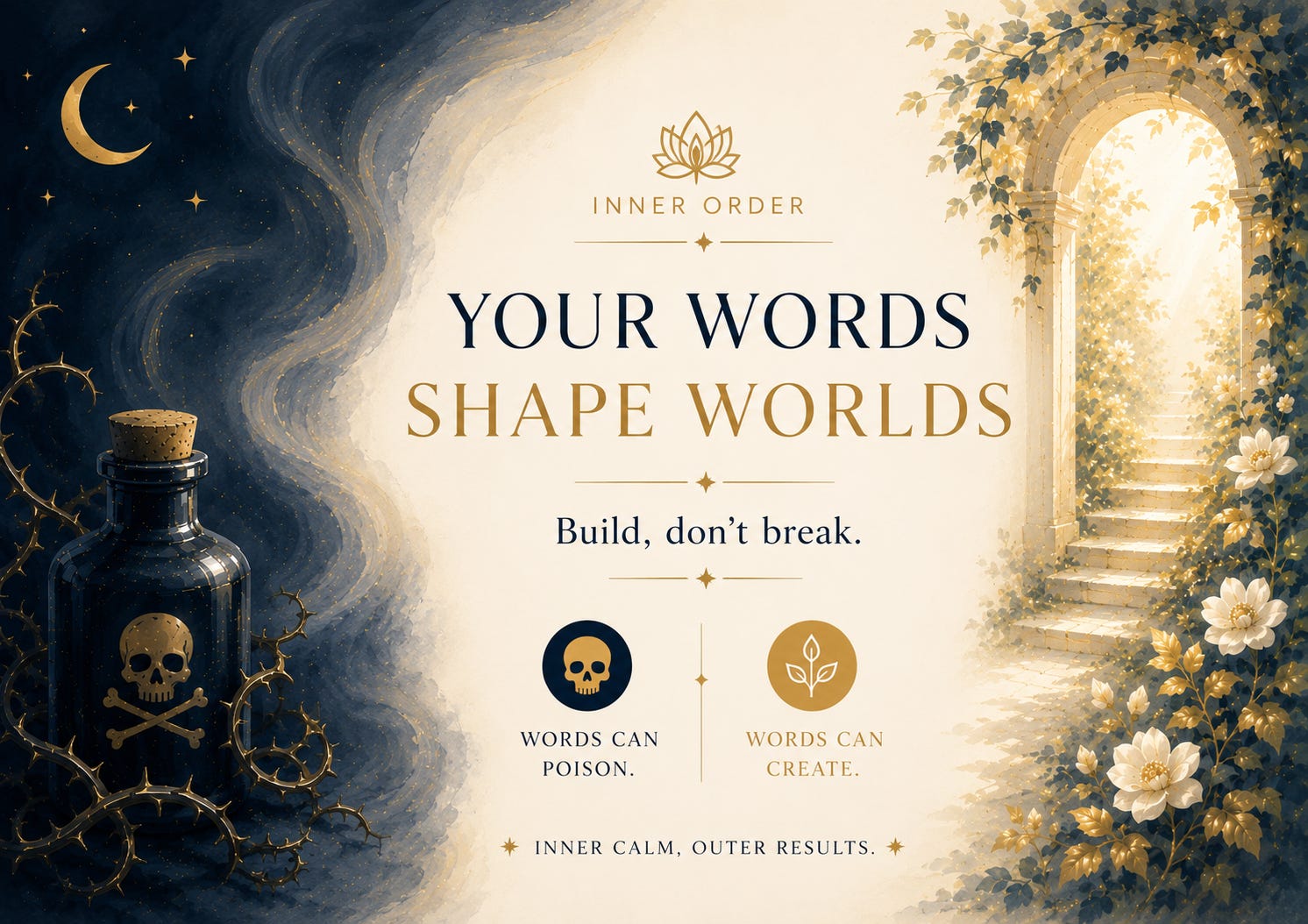
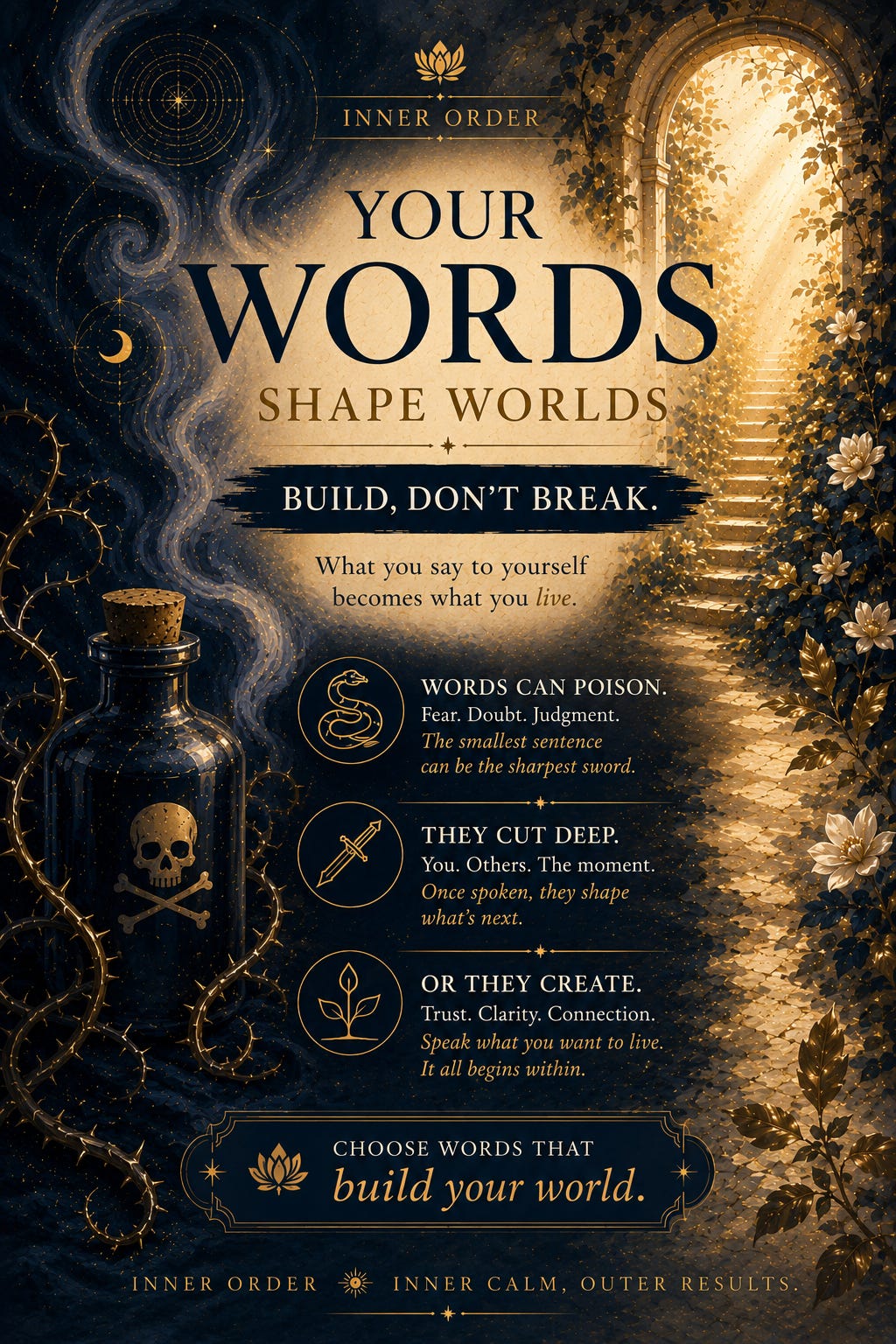
The word is the most powerful tool you have as a human; it is the tool of magic. But like a sword with two edges, your word can create the most beautiful dream, or your word can destroy everything around you.
Don Miguel Ruiz · The Four Agreements
A sword doesn’t stop being a sword when it’s used carelessly. It’s the same edge either way. Nobody hands you that information when you’re handed the ability to speak. You learn words the way you learn to walk, by doing it constantly, with no manual, no warning label, no one sitting you down to say this thing you’re about to use for the rest of your life carries the power of God in it. You just start talking. So do the people around you. So did the people raising them.
Which means a parent who says something sharp to quiet a crying child, a sibling who says something cruel without thinking twice, a friend repeating gossip because everyone else is doing it too, none of them know what Ruiz is describing. They think they’re using an ordinary, weightless thing, a sentence, a comment, a joke. They have no idea what’s actually moving through them while they believe they’re just talking, and a single careless sentence like that is often how an old belief gets treated as settled fact, decades before anyone thinks to check whether it ever was.
How the poison spreads, including back to you.
Ruiz doesn’t stop at naming the power. He’s specific about what most people actually do with it: spread their own anger, jealousy, and hate, calling it ordinary conversation the whole time. And the part that’s easy to miss on a first read is who else gets hit. Not just the person it was aimed at. Poison doesn’t stop where it lands.
The friend who repeats the gossip absorbs a little of it too, even as they spread it. The parent who snaps at the child is not unaffected by their own words. And the words you aim at no one but yourself, under your breath, about your own face, your own mistakes, your own worth, do exactly the same damage with exactly the same power, because the word doesn’t check who it’s pointed at before it works.
This is why poison spreads the way it does, through families, through friend groups, through entire histories, without anyone involved ever deciding to be the source of harm. Nobody wakes up intending to poison the people they love. They simply never learned that the ordinary, weightless-feeling thing coming out of their mouth carried any weight at all. They were never taught. So they keep doing what was done to them, certain the whole time that they’re just talking. Which means every time you poison someone else, you’re standing close enough to breathe it in too.
Almost nobody is trying to poison anyone. So why does the same sentence keep coming back, year after year, like it’s the only one available?
Why a careless word sticks once it lands.
Every one of those moments, the sharp comment, the gossip, the thing you mutter at yourself in the mirror, follows the same arc over time. The first time it happened, whatever it was, you didn’t know. You couldn’t have. But by the tenth time, the fiftieth time, some part of you had gotten used to it. Not the harm itself. The shape of it. The familiar groove of reaching for the same sharp words, the same old complaint, the same line about yourself, because it was already worn smooth from use.
Neville Goddard named exactly that, and didn’t soften it either.
Everything in the world bears witness of the use or misuse of man’s inner talking. Through habit man has developed the secret affection for these negative inner conversations. Through them he justifies failure, criticizes his neighbors, gloats over the distress of others, and in general pours out his venom on all. Such misuse of the Word perpetuates the violence of the world.
Neville Goddard · Be What You Wish
Secret affection is the line that does the real damage here. Not ignorance anymore. A habit. Something you return to, almost on purpose, the way you’d return to anything familiar, long after the not-knowing has worn off. That’s why a comment made once when you were eight can still be running quietly at forty. It didn’t stay out of confusion. It stayed because nobody ever told you it was something you were allowed to put down.
Awareness doesn’t fight the old sentence or argue it down. It simply knows, in a way you didn’t before, that what you’re still speaking with was never a small, true fact about you. It was an ordinary person, or an ordinary version of yourself, holding the same sword Ruiz described, the one with two edges. You didn’t know at first. Then you got used to not looking. The two words you say most often have always carried that much weight. Almost nobody simply knew it, and almost nobody keeps checking once they do.
What I didn’t know I was doing with my own words.
I run hot. I always have. Someone says the wrong thing, or nothing at all, and I’m already reacting before I’ve caught up to myself, and what comes out in that moment has hurt people I love. For a long time I called it just my temper, the way you’d mention a fact, something fixed, something separate from anything I could actually be responsible for.
There’s a particular kind of quiet that happens after, once the words are already out and you can’t call them back. I know that quiet well. I’ve stood in it more times than I want to count, watching someone’s face change because of something I said in five seconds that took them a lot longer to stop carrying. Some of those people forgave me long before I forgave myself.
I wasn’t aware, not really, of what I was speaking with in those moments. I knew I was upset. I didn’t know I was swinging the edged side of something most people only ever see the gentle side of.
Nothing changed by trying to be calmer through effort alone. What changed was simply knowing, finally, what was actually moving through me every time I opened my mouth. Once I couldn’t unknow that, I couldn’t throw it carelessly the same way again. Not perfectly. Not every time. But I couldn’t call it nothing anymore, and that was enough to start.
I wasn't trying to poison anyone, not at first. But some part of me got used to the shape of it long before I ever stopped to ask what I was actually speaking with. Understanding what was happening was never the hard part. I'd understood it for years. Knowing a thing and being able to stop your own hand in the moment are two entirely different kinds of work, and the gap between them is where most of us actually live.
You weren’t taught what you were speaking with either, and neither was anyone who’s ever poisoned you. That single piece of awareness, just knowing what the word actually is, does most of the work before any technique or practice even enters the picture. It was always something you were already saying, just never something you’d stopped to hear. There’s a deeper question underneath all of this, who is actually speaking when you speak, and that one is worth its own conversation another day.
For now, here’s where to actually start. Not with the words you’ve already said. With the ones forming right now, before they leave your mouth.
The next time you feel a sharp sentence building, about someone else or about yourself, stop and name what’s actually moving through you. Not the feeling behind it. The sword itself. Say it plainly, even just in your own mind: this is the same power that built everything, and I’m about to swing it. That single naming changes the speed of the moment. You can’t reach for something carelessly the instant you’ve called it by its real name.
Then ask one question before the sentence finishes forming. Is this the edge that creates, or the edge that destroys. You’ll usually know immediately. The answer doesn’t always change what you do next. But it changes whether you’re doing it awake or doing it asleep, and asleep is how every one of these sentences got started in the first place.
Do that once today. Then once tomorrow. The sword doesn’t get lighter. You just get better at feeling which edge is facing out before it leaves your hand.
What’s the last thing you said, to someone else or to yourself, that you’d take back if you’d known then what you know now?
Awareness like this isn’t a one-time read, it’s a practice, and it’s the foundation everything in Inner Order is built on. If you’re ready to stop catching this after the fact and start catching it before, that’s exactly what we work on together inside.
Adele
Let me share my perspective here 😁
I also think there is power in words, but I strongly believe it has to do with intent, either from you or from others. When you say words with intent, like when you actually mean them, there’s a resonating power… from the cosmos, or maybe something that carries the weight of intent around them.
It’s like the words stop being just sound and become a signal.
When intent is behind them, words don’t just describe a reality, they lean into it. They gather momentum. A casual “you’ll be fine” passes through someone. But a “you’ll be fine” said with true conviction can anchor them when they’re slipping.
I think that’s why empty praise feels hollow, and why a single honest sentence from the right person at the right time can rearrange you. The intent does the work the syllables can’t do alone.
Maybe the cosmos isn’t magic in that moment. Maybe it’s just physics of attention — when meaning is fully present, people, and maybe the world, respond to it differently. The intent becomes the carrier wave, and the words ride on it.
So yes, words have power. But intent is what makes them heavy enough to leave a mark.
Īrē o ✌️
So true. Negative self-talk is a battle I'm constantly fighting.