
The File You Never Updated
How old identity conclusions shape perception and limit what feels possible now

When I was younger, I used to walk into rooms already prepared.
Prepared to be misunderstood. Prepared to not fit. Prepared to be too much, or not enough, or somehow both at once.
Nobody in the room knew that. But I did. And here’s the part that took me the longest to see:
The room was brand new. The people were new. The day was new.
But my mind wasn’t.
It had already decided what this moment meant, based on twenty others that looked vaguely similar. I wasn’t seeing the room. I was seeing the past wearing the room’s clothes.
There was a job interview I went to once where I was genuinely well-qualified. I knew the material. I had prepared. And from the moment I sat down, some part of me was already apologizing for being there, already performing smallness, already making myself easier to dismiss before anyone had the chance to dismiss me. I didn’t get the job. I’ve thought about that interview a lot since then. Not with regret, but with curiosity. Because I understand now what was happening: I wasn’t responding to that room. I was responding to every room before it that had made me feel like an inconvenience.
This is one of the quietest, most consequential things the mind does. It takes a present moment and runs it through the filter of every similar moment in the past. It pattern-matches at lightning speed, and then it hands you a conclusion before you’ve even finished looking. This is the loop that writes the story of what things mean before you have finished experiencing them.
And the conclusion is rarely about now. It’s almost always about before.
The File System Nobody Tells You About
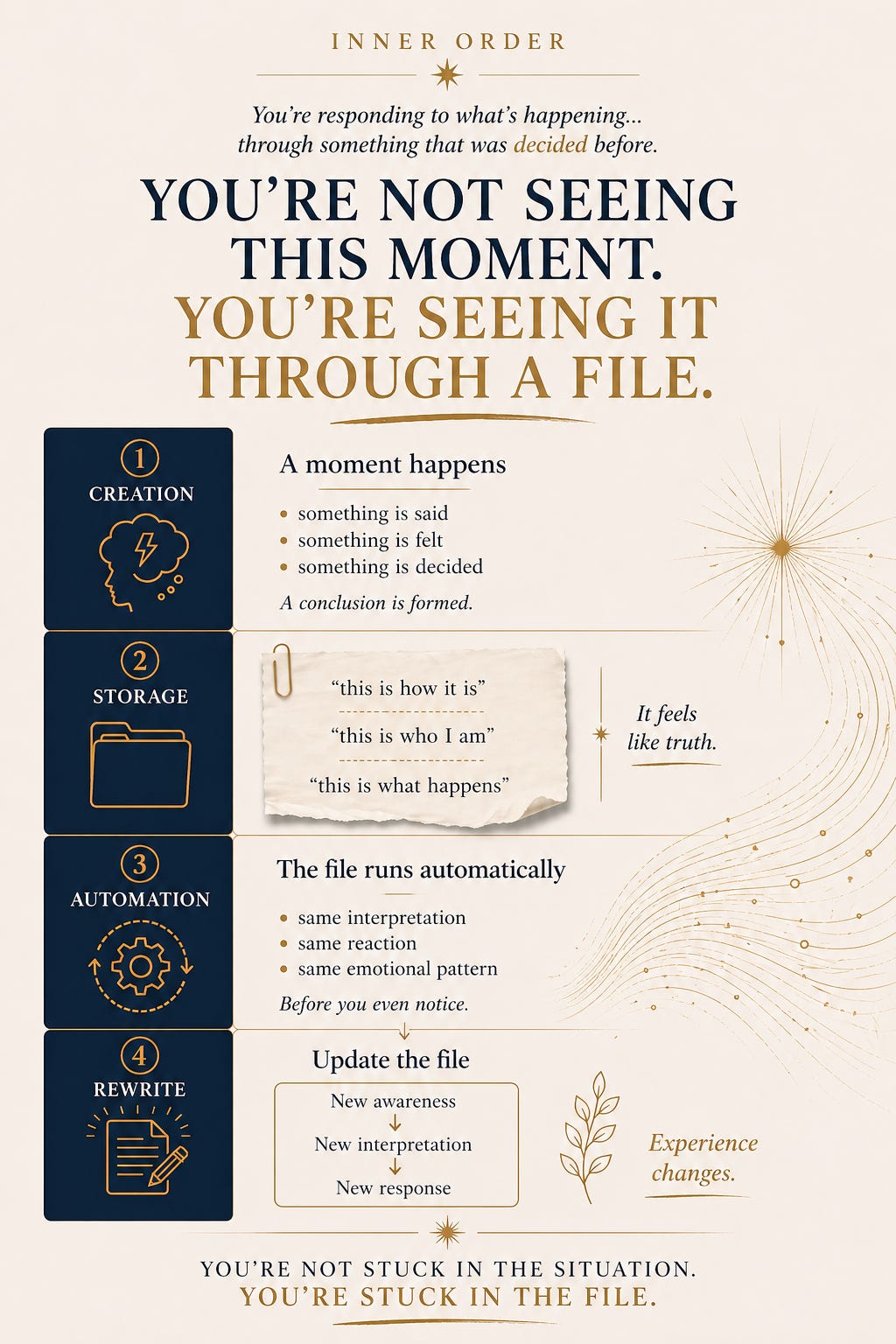
Think of your identity as a filing system that was built mostly in childhood and early adulthood, compiled from the things people said about you, the ways you were treated, the conclusions you drew from the experiences that shaped you.
“I’m the kind of person who has to work twice as hard to be taken seriously.”
“I’m the kind of person who gets left when things get hard.”
“I’m the kind of person who is a lot to handle.”
None of these were consciously chosen. They were conclusions drawn from data, real experiences, real pain, real moments. Beneath many of them are the two words that are quietly running the show. And at the time, they made perfect sense. They were the mind’s way of making meaning from something that hurt.
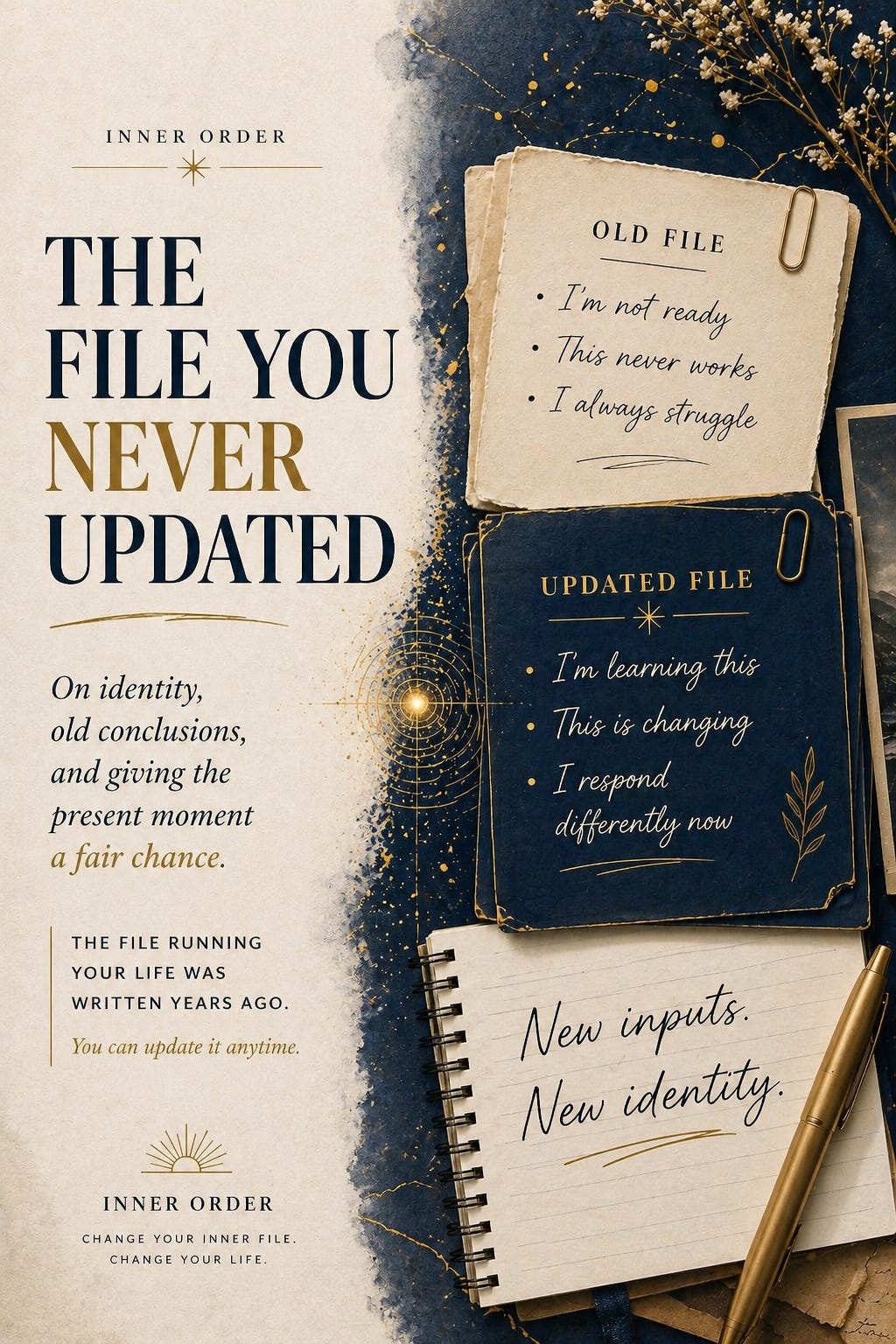
The problem is that the file never got updated.
The experiences that created those conclusions may be decades old. The people involved may be long gone. The circumstances may have changed entirely. But the file still runs. Automatically. Below the level of conscious awareness. Shaping how you walk into rooms, how you interpret silence, how much you allow yourself to want, how quickly you make yourself smaller before anyone else gets the chance.
You’re not reacting to today. You’re reacting to a version of you that got hurt once and never updated the file.
“The moment you change your perception is the moment you rewrite the chemistry of your body.”
- Dr. Joe Dispenza
And the heartbreaking part is that you can’t see it while it’s happening. It feels like perception. It feels like realism. It feels like just knowing how things go. But it’s not knowing. It’s remembering. And memory is not always a reliable guide to the present moment.
What Identity Has to Do With Prosperity
This is where the prosperity conversation gets real.
“The world without is a reflection of the world within. What appears without is what has been found within.”
- Charles F. Haanel
Most people approach abundance from the outside, better strategy, better habits, better content, better offer. And then they wonder why, even when the strategy is working, something underneath keeps quietly pulling them back to a familiar level.
It’s the file. It’s always the file.
If your identity holds a deeply embedded belief that people like you don’t get to have what you’re reaching for, that success is for other people, that prosperity is somehow suspicious, that wanting more is greedy or naive, then no strategy in the world will fully override it. Because identity doesn’t just shape how you feel. It shapes what you allow. What you pursue. What you unconsciously sabotage right before it arrives.
“To change your life, you must first change your perception of it.”
- Marianne Williamson
Perception lives inside identity. And identity lives inside that filing system you’ve been running since before you understood what a belief even was.
Updating the file is the work. This is what the inner work that actually changes things looks like. Not affirmations pasted over the top of an old story, actual, deliberate revision of the conclusions that have been quietly running your life.
The Bravest Thing You Can Do
It isn’t dramatic. It doesn’t require a breakdown or a revelation or a retreat in the mountains.
It’s just, noticing.
“I seem to be thinking about being judged.”
“I seem to be thinking about failing again.”
“I seem to be thinking about being left.”
Not fixing it. Not shaming it. Not immediately trying to think yourself into a better feeling place. Just the clean, honest act of noticing that the thought is there, and recognizing it as a thought, not a truth.
Because the moment you can observe a belief, you are no longer entirely inside it. There is a you that is watching. And that watching self is not the belief. It never was.
I remember the first time I caught myself mid-walk thinking about a conversation I’d had three days earlier, rehearsing what I should have said, rewriting the ending in my head, defending myself to someone who wasn’t even there. And I just, stopped. On the path. Literally stopped walking. And said out loud, very quietly: “That was three days ago. What is actually in front of me right now?” Birds. Trees. The sound of my own breathing. The present was completely fine. I had been somewhere else entirely.
That’s the practice. Not the dramatic transformation. The quiet return. Again and again, until the present becomes more real than the past.
When you notice you’re seeing the past, you finally give the present a chance. And the present is usually far kinder than your memory.
How You Begin to Update the File
You don’t update an identity file by arguing with it. You update it by accumulating new evidence that contradicts it, slowly, consistently, until the new data becomes the dominant story.
This means:
Noticing when the old conclusion arrives, and pausing instead of performing it.
Asking: Is this actually true right now, in this moment, with these people?
Taking the action the old file would have prevented, even slightly, even imperfectly.
Collecting the evidence that the new story is also true.
Blessing what shows up, even the small things, so the new story has something to build on.
This is slow work. It is not linear. There will be days when the old file runs so fast you don’t even notice until after. That’s not failure. That’s the process.
The goal isn’t a perfectly updated identity. The goal is a more honest relationship with the one you have, so it stops running you without your knowledge.
Letting the Present Moment Be New
Every room you walk into is new. Every conversation, every opportunity, every ordinary Tuesday morning, new.
The present moment is not the past. It does not know your history. It is not pre- loaded with the conclusions that hurt you. It is simply, here. Available. Waiting to be met on its own terms.
Inner Order is, in large part, the practice of learning to meet it there. Not dragging the past into the room before you’ve even sat down. Not rehearsing the ending before the story has begun.
Just arriving. Fully. In the actual moment. With all the curiosity of someone who genuinely doesn’t know yet how this one goes. Often what feels like certainty is actually the ceiling I kept calling realism.
“Realize deeply that the present moment is all you ever have.”
-Eckhart Tolle
Because you don’t. And that, it turns out, is not a problem.
It’s the whole point.
Next up: The Wrong Column, where your energy is actually going, and why the things that quietly move your life never make it onto a to-do list.
Which room do you keep walking into already decided? Not the room itself, the inner one. The conclusion you carry in before anything has happened. You do not have to explain the whole story. Just name the pattern. I will be in the replies.
If someone you know keeps replaying the same pattern in new situations, this piece names what is happening underneath. Worth sharing.
If this piece spoke to something you have felt but never quite had language for, you may want to subscribe. The work here is about understanding the quiet structures shaping our lives, and learning how to relate to them differently.
Share this article on Pinterest:
Something I’ve noticed over the years is how convincing familiarity can feel.
Not truth — familiarity.
A reaction appears, a hesitation, a quiet assumption about how something will unfold… and because it feels known, the mind treats it as accurate.
But the present moment has never actually agreed to that contract.
It hasn’t promised to behave like the last ten moments that looked similar.
There’s something strangely freeing in remembering that.
Not everything that feels predictable is inevitable. Sometimes it’s just a habit of interpretation that’s been running for a long time.
And habits, thankfully, can be noticed.
Which means they can also loosen their grip.
Wow there is so much truth here! Isn't it interesting that we move through life never updating our own files? I've just had this brought to my attention recently, and it's something I'm actively working on. But we don't know what we don't know, right? Until someone says it out loud, we just keep on going on in the same way and wondering why things are so hard. I wish you the best of luck on Substack, clearly the information you have to share is very interesting and much needed!