
Inner Order: The Missing Foundation No One Talks About
Why external improvement never quite creates internal stability and what actually does.

You can upgrade your habits.
Refine your morning routine. Read better books. Even earn more money.
You still lie in bed with a mind that won’t power down.
Still wake up with that low-grade pressure before your feet hit the floor. Still feel like you’re doing everything right, and still feel, quietly, like something is off.
That’s not a discipline problem. That’s not a strategy problem. And it’s definitely not a “you” problem.
It’s a foundation problem. And almost nobody talks about it.

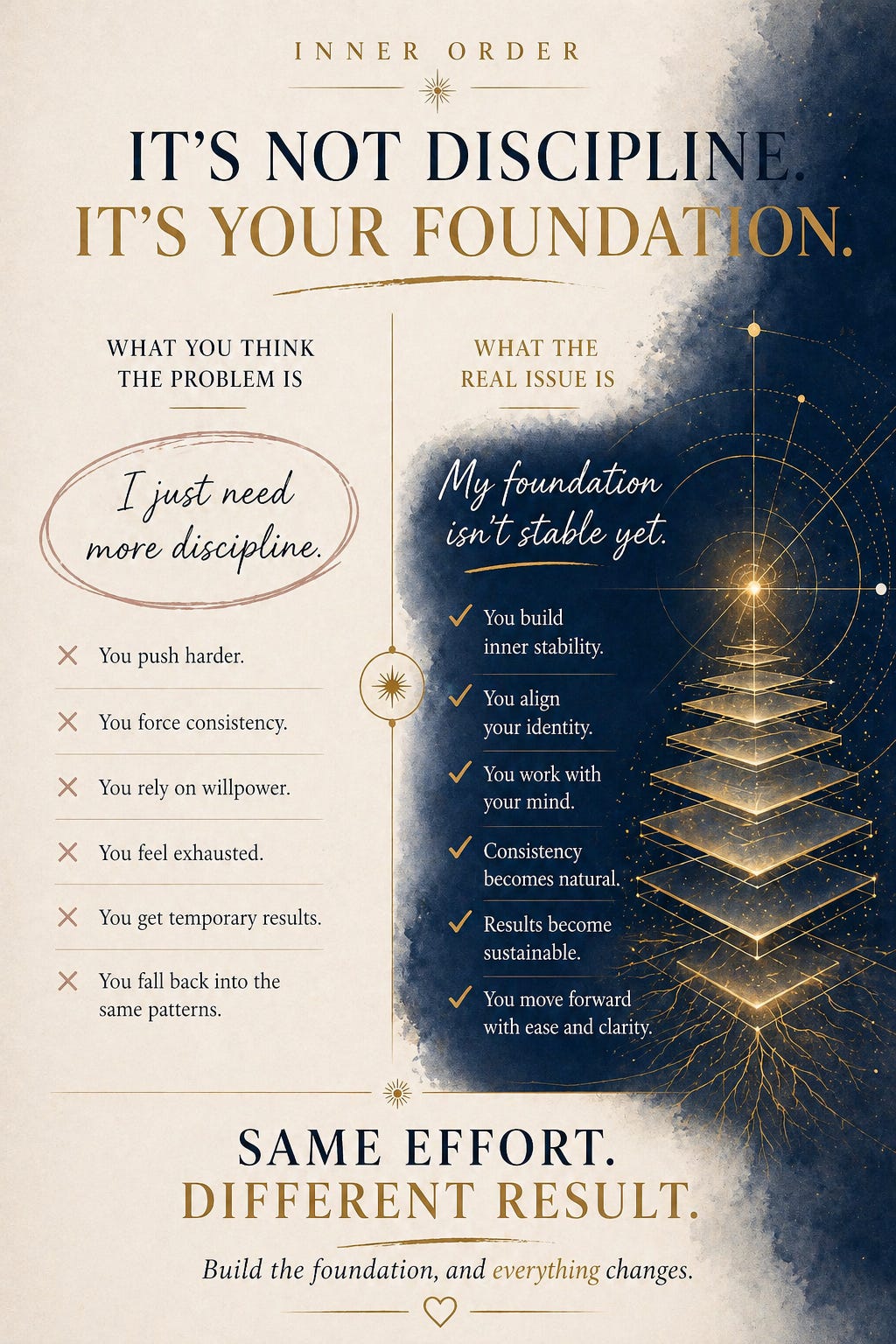
I spent a long time trying to fix my outer life while my inner world quietly ran the show. I’d read the books, all of them, more than once. I understood the principles. I could talk about vibration, consciousness, and the law of attraction until someone’s tea went cold. And yet there was this persistent hum of unease underneath everything. Not loud. Not dramatic. Just, there. A kind of low-grade restlessness that no new planner or productivity system or inspired Instagram post could quite reach. It took me longer than I’d like to admit to realize that I had been trying to change my life from the outside in. And the outside-in approach has a ceiling. A very frustrating, very invisible ceiling.
The Outside-In Illusion
Most personal development starts from the outside. New habit. New routine. A new affirmation stuck to the bathroom mirror. New strategy downloaded from a podcast. And some of it helps, genuinely. But there’s a layer underneath all of it that most approaches never quite reach. Most of what exhausts people isn’t effort. It’s the way experience is quietly interpreted before they are even aware interpretation is happening, the mind that decides what things mean before you have finished experiencing them.
The internal structure that interprets everything. The invisible framework of assumptions, beliefs, and identity that runs beneath the surface, organizing how you see yourself, how safe you feel, how worthy you believe you are of the things you say you want. The identity file that was written before you knew you were writing it.
When that framework is disordered, when there’s conflict between what you say you believe and what you actually feel at 2 am, no amount of external change resolves it. You can move cities, change careers, find a new relationship, and bring the same internal noise with you every single time.
“Seek not to change the world, but choose to change your mind about the world.”
- A Course in Miracles
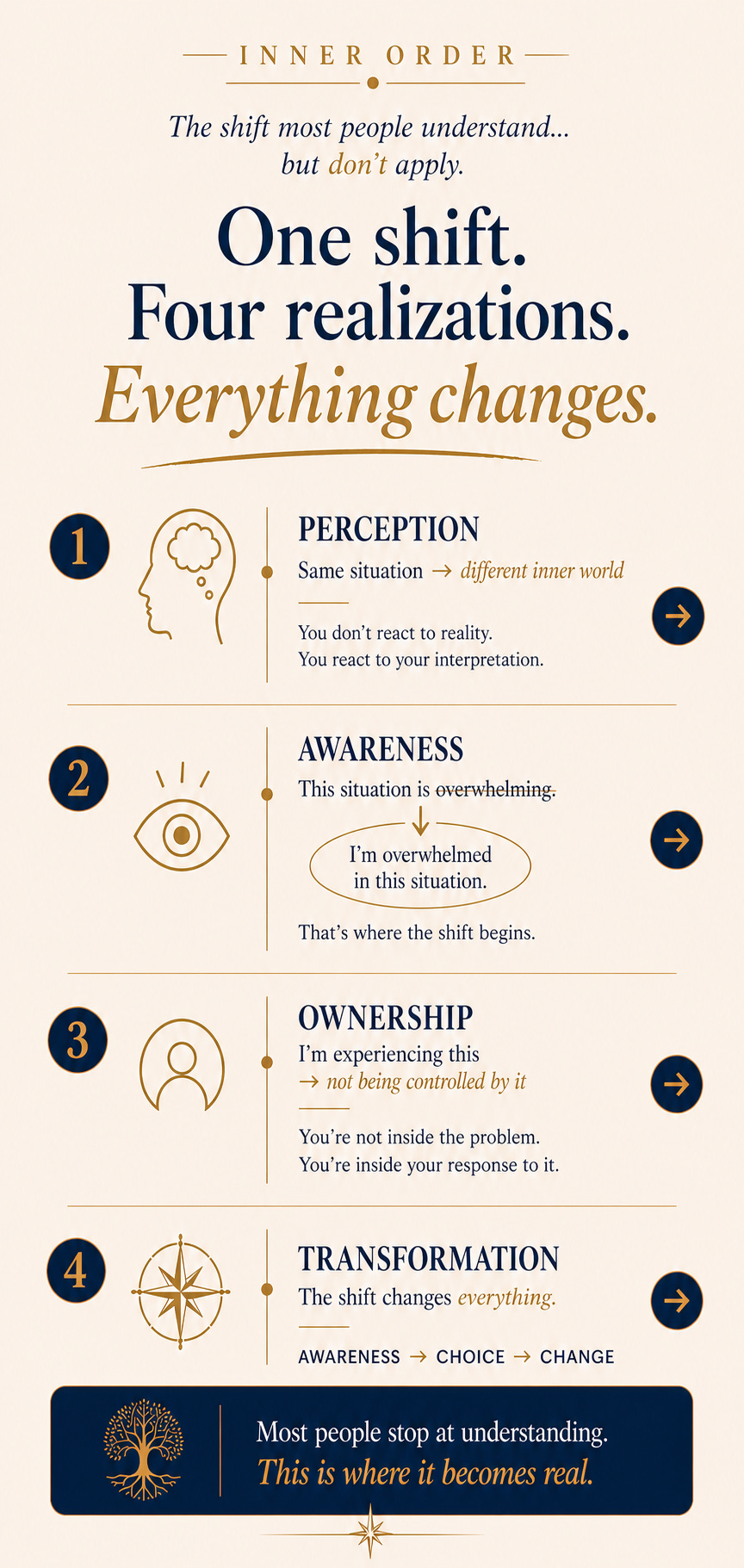
That isn’t abstract spirituality. It’s the most practical instruction I’ve ever read. Because when perception is distorted or reactive or fragmented, the world feels unstable, even when it objectively isn’t.
A restless inner world makes even a stable outer life feel uncertain.
And that restlessness doesn’t always look dramatic. Sometimes it looks like overthinking a simple decision for three days. Replaying a conversation that ended fine. Feeling behind even when you’re technically on track. Achieving something you wanted, and immediately moving the goalpost so you never quite arrive.
Subtle. Exhausting. And completely invisible to everyone around you.
So What Is Inner Order, Actually?
Inner Order is not positive thinking. It is not suppression, not spiritual bypassing, not pretending everything is fine when it isn’t.
Inner Order is the disciplined alignment of three things:
Perception - what you notice and how you interpret it
Belief - what you hold as true beneath the surface
Identity - who you understand yourself to be
When those three are in conflict, life feels noisy, even when nothing is technically wrong. When they are aligned, life feels coherent. Decisions feel simpler. Rest feels earned without having to earn it. Prosperity stops feeling like something you’re chasing and starts feeling like something you’re moving within.
Here’s a common example of inner conflict most of us never name:
You say you believe in abundance. But you perceive threats in every unexpected expense. And your identity is quietly built around being the one who has to work twice as hard just to stay safe.
That’s not a manifestation failure. That’s an internal contradiction. And you cannot think your way out of an internal contradiction. You have to go in and resolve it at the root.
“God is circulation.” - Raymond Charles Barker
Circulation, of ideas, opportunity, love, money, cannot move cleanly through inner contradiction. Not as punishment. Not as fate. As a pattern. The same way water can’t flow freely through a kinked hose, no matter how good the water source is.
Why Your Mind Won’t Settle
Without a steady inner order, the mind tries to manage everything at once. It scans for threats. Replays past mistakes. Anticipates future losses. It becomes defensive rather than directed, working very hard to protect you from dangers that mostly exist in the interpretation, not the reality.
Your dominant inner state shapes your lived experience. What you consistently dwell on, you live from. This isn’t woo. It’s neuroscience. Repeated emotional states strengthen neural pathways, making certain interpretations automatic over time, until bracing for impact becomes your baseline, and you stop noticing that it doesn’t have to be.
“The brain does not know the difference between an experience in the outer world and an experience vividly imagined.”
- Dr. Joe Dispenza
This is why effort alone doesn’t create ease. You can work harder and harder and still feel like you’re standing in quicksand. Because the effort is happening at the level of circumstance. And the problem is happening at the level of consciousness.
Order does what effort can’t.
You don’t need more effort. You need more order.
What the Inner Work Actually Means
This is where most conversations about mindset stop, conveniently, right before the useful part.
Inner work is not repeating affirmations over a baseline of fear. It is not suppressing what you feel, so you can perform positivity. It is not pretending you’re fine when you’re not.
Real inner work means noticing the beliefs beneath your reactions, the ones that have been running quietly in the background since long before you started reading personal development books. It means bringing perception back under conscious direction; instead of letting it run on automatic. It means interrupting the loop between fear and interpretation before it writes the whole story.
“I am responsible for what I see.”
- A Course in Miracles
That statement isn’t about blame. It’s about authorship. When you take responsibility for your perception, not your circumstances, your perception, you gain the ability to reorder it. Language begins to reflect identity long before behavior changes, the two words quietly organizing experience. And when perception is reordered, identity begins to settle. When identity settles, action becomes simpler. When action becomes simpler, results follow, not through force, but through alignment.
Outer change becomes a byproduct of inner work. Not the other way around.
What Changes When Order Is Restored
The changes that come from inner order aren’t always dramatic. They’re often quiet. Which is exactly how you know they’re real.
You wake up, and your first thought isn’t already solving a problem. A delayed text is just a delayed text, not a signal that something is wrong. An unexpected expense doesn’t collapse your sense of security. Rest doesn’t need to be earned. Silence isn’t dangerous.
Money starts to feel like circulation rather than proof of your worth. An idea comes, and instead of immediately talking yourself out of it, you write it down. You make a decision, a real one, and you don’t spend three days second-guessing it.
Calm becomes your baseline. Not a reward for getting everything right. Just, where you live.
That’s what inner order actually feels like from the inside. Not perfection. Not the' absence of difficulty. Just a steadiness underneath that difficulty can no longer be fully shaken.
Prosperity stops being something you pursue and starts being something you participate in. Because you are no longer spending your energy managing the noise.
When the inside steadies, the outside reorganizes. Naturally. Quietly. Reliably.
The Real Intention
Most personal development teaches you how to improve your circumstances.
How to be more productive, more disciplined, more strategic. And those things have their place.
But very few conversations go deeper than that. Very few ask: what is the inner world from which all of that action is coming? Is it ordered? Is it aligned? Is it actually a foundation, or is it just a very busy surface?
Inner Order is about that foundation. It stabilizes the internal structure directing where your life is actually being built from, the internal structure directing where your life is actually being built from. The steadiness underneath. The quiet internal architecture that either supports everything you’re building, or quietly undermines it.
The intention here is not to help you improve your circumstances. It is to help you restore your inner order. And let everything else follow from that.
Because it will.
It always does.
If something in this felt familiar, not new, but remembered, that recognition is worth paying attention to.
Stay close. Because this is just the beginning.
Where in your life have you upgraded everything on the surface and still felt something underneath not quite settled? Not the dramatic version. The quiet one. The version that keeps showing up no matter how much you improve what is visible. Tell me in the comments. I read every one.
If you know someone who is doing everything right and still feels like something is off underneath, this piece is for them. Restack or send it directly.
If this spoke to something you have felt but could not quite name, you are exactly where you are meant to be.
Inner Order is not about becoming someone new. It is about restoring the structure that allows everything you are building to hold.
Subscribe to receive the next piece as it is released. Your Nervous System is not the Enemy.
Quiet change. Real change.
Share this article on Pinterest:
Most people try to fix circumstances.
I’m more interested in this:
Where does your mind go when nothing is actually wrong?
Morning?
Money?
Relationships?
Future?
I’m curious.
Honest Question:
When you wake up in the morning, what is your first thought?
Neutral
Bracing
Planning
Worrying
Grateful
Something else?
Just one word.