
The Two Words That Are Writing Your Life
And Why Almost Everyone Uses Them Wrong

You say them dozens of times a day without noticing. And every time you do, something is being built.
In the last piece in this series, I wrote about the state, about how your experience is not generated by what you do but by what you are. The totality of what you carry about who you are and what the world is likely to do. And how that state rewrites itself on Wednesday no matter how hard you tried to shift it on Monday.
Today I want to go to the root of it. Because if the state is what generates experience, and the self-concept is what forms the state, then the question becomes: what is forming the self-concept, moment by moment, in the ordinary hours of an ordinary day?
The answer, as Neville Goddard understood it, is two words.
I AM.

The Most Creative Force in Your Life
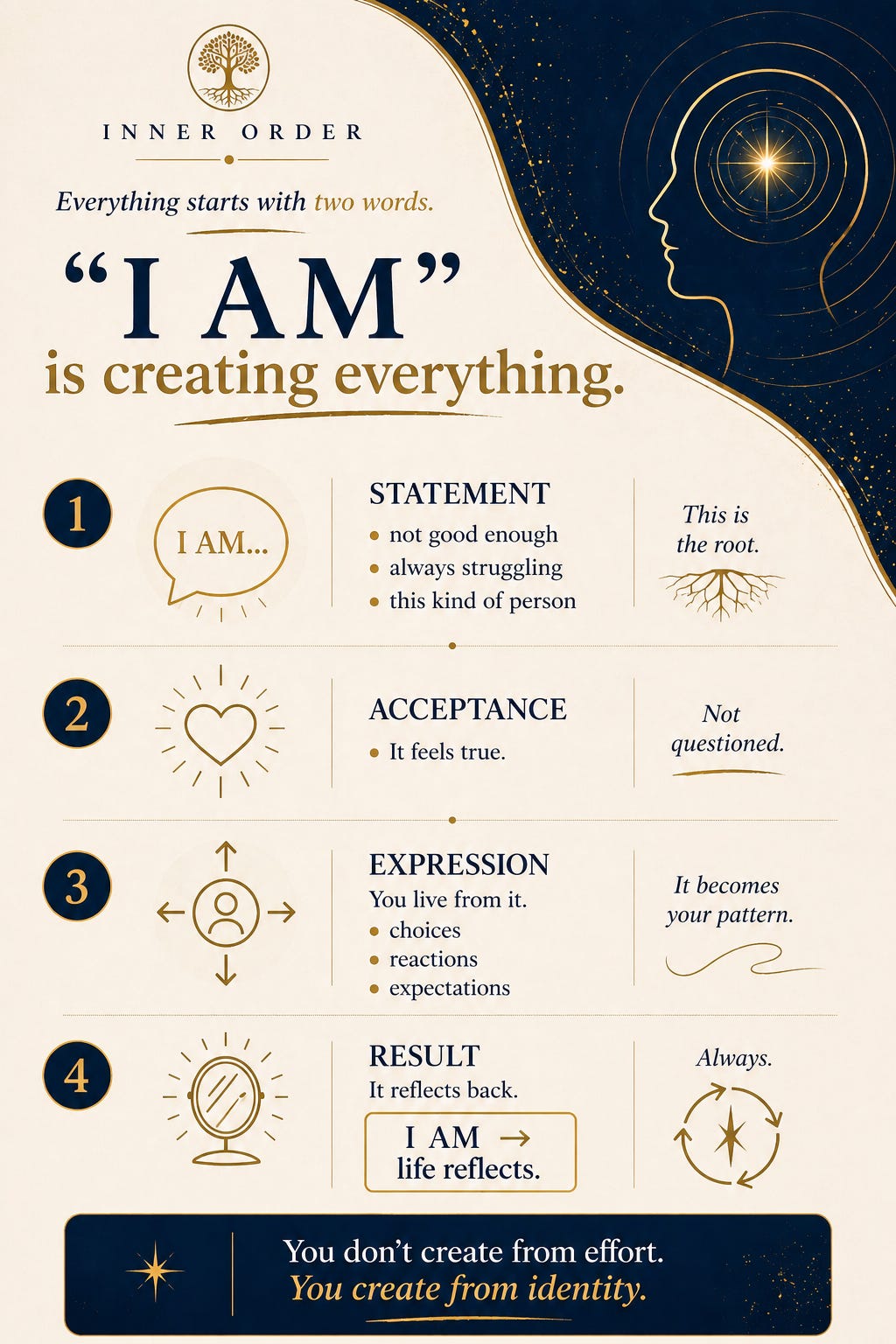
Neville Goddard spent more time on the I AM than on almost any other teaching. Not because it was abstract philosophy, but because he understood something precise about it: every statement that follows those two words is not a description of who you are. It is a declaration. And declarations, held with feeling and repetition, become the architecture of the inner life from which all experience flows.
This is not metaphor. And he was not being poetic when he wrote about I AM. He was pointing at a mechanism.
“I AM is the name of God, and beside this name there is no other God. Man’s greatest mistake is to use this sacred name in vain. Every time you say ‘I am sick,’ ‘I am broke,’ ‘I am afraid,’ you are using the name of God in vain.”
Neville Goddard
Neville Goddard (1905-1972). His teaching on the I AM draws on the oldest traditions of consciousness philosophy, reframed as a precise instruction for daily inner life. Not theology. Practical mechanics.
Using the name in vain. That phrase stopped me the first time I read it, because it reframes something entirely. Using I AM carelessly is not merely imprecise language. It is, in Neville’s framework, the primary mechanism by which people build their own ceilings.
Every I AM statement is a declaration to the deepest layer of consciousness, the part that does not evaluate or argue, that accepts whatever is given as instruction. And that layer executes faithfully. Without question. Without hesitation. Without any interest at all in whether what you told it is what you actually want.
What You Are Actually Saying All Day
Most people, if you asked them what they say after I AM, would give you the acceptable version. I am capable. I am working on myself. I am getting better at this.
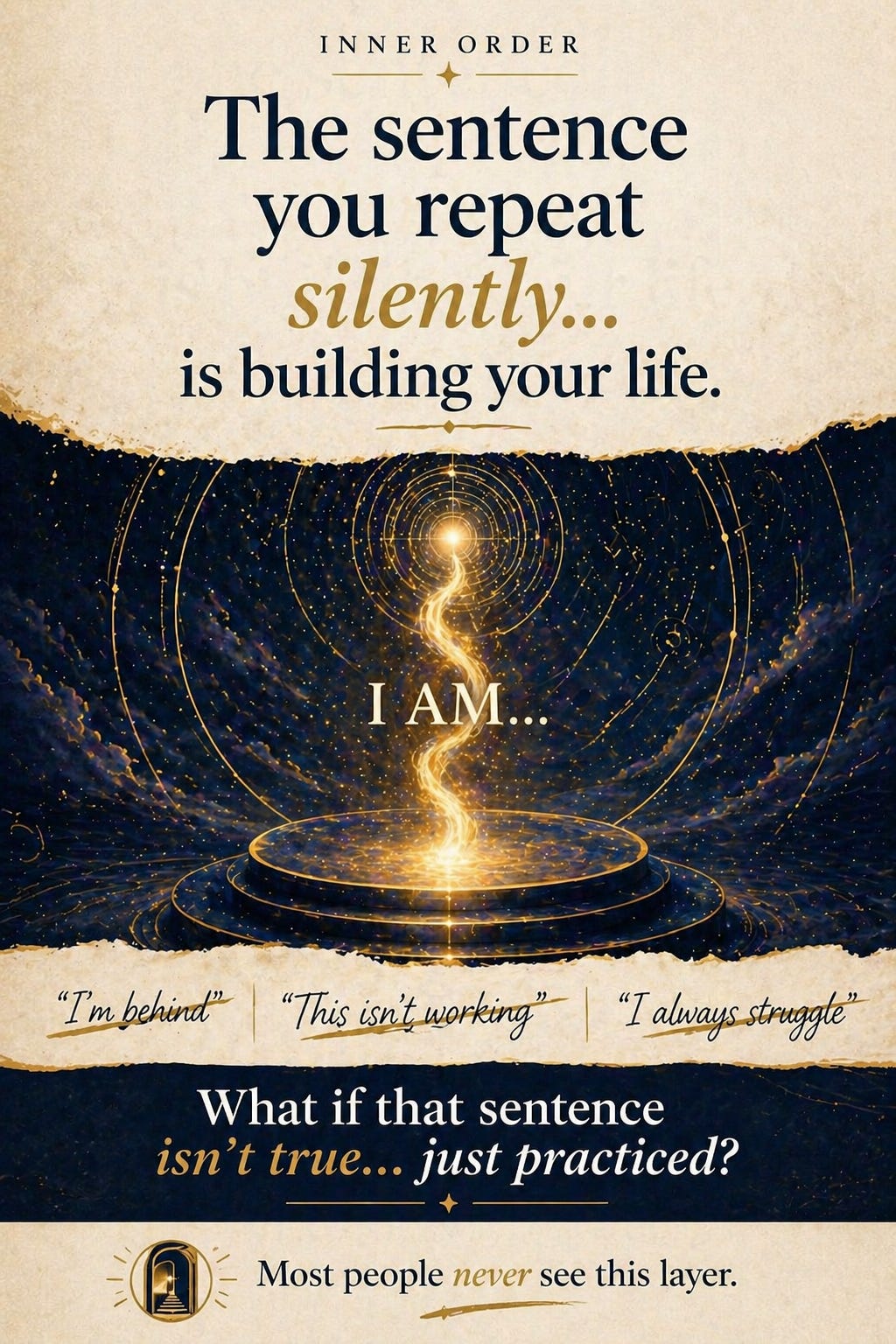
But the I AM statements that do the most work are rarely the ones you say out loud. They are the ones running underneath. The ones that arrive in the space between stimulus and response, before the conscious mind has had a chance to intervene.
I am the kind of person who always ends up carrying this alone.
I am not someone things come easily to.
I am almost there, but not quite.
I am someone who has to work twice as hard for half the result.
None of these are dramatic. None of them arrive with fanfare. They are quiet, quick, entirely ordinary, and they have been running for years. They feel like simple observations about how life goes. They feel like realism. What they actually are is instruction, given repeatedly to the part of the mind that builds accordingly.
The self-concept is not built from your intentions. It is built from your I AM statements, the ones you mean and the ones you say without noticing.
Why Affirmations Don’t Always Work
This is the precise reason that positive affirmations, for most people, produce very little. Not because the principle is wrong. Because the application is backwards.
You cannot layer I am abundant over the top of I am someone who never quite has enough and expect the new statement to win. The deeper statement has years of repetition behind it, years of emotional reinforcement, years of evidence gathered by a mind looking for confirmation of what it already believes.
The new affirmation gets five minutes in the morning, said into a mirror with a degree of hope and a quiet internal voice asking: but do you actually believe that?
The older statement, the one running beneath awareness, gets the rest of the day.
I did this for a long time. I was meticulous about my morning practice. I chose the right words. I said them with feeling. I believed, at the level of conscious intention, every word I was saying. And nothing much shifted. It took me longer than I’d like to admit to understand why. The affirmations were landing on a foundation that contradicted them. The foundation was built from I AM statements I had never examined. They were quiet, fast, and entirely in charge.
What Neville Goddard Was Actually Teaching
When Neville Goddard taught about the I AM, he was not teaching people to be more careful with their words. He was pointing at something deeper. The I AM is the creative center. It is the point from which the inner world is continuously generated. And the inner world, as the first piece in this series explored, is always the cause of the outer one.
Which means the project is not to manage what follows I AM more carefully, though that matters. The project is to examine what is already there. What statements have been running, for how long, with what degree of feeling and certainty attached. To find the ones that were installed before you knew you were installing anything.
“Change your conception of yourself and you will automatically change the world in which you live. Do not try to change people; they are only messengers telling you who you are.”
Neville Goddard
Do not try to change people. They are only messengers telling you who you are. Every relationship difficulty, every pattern that repeats, every situation that seems to follow you from one context to the next. These are not bad luck or other people’s behavior. They are the I AM, reflected back.
That is a confronting idea. I have found it also, once you sit with it long enough, to be one of the most liberating ones I know. Because if the pattern is coming from the I AM, then changing the I AM changes the pattern. Not the people. Not the circumstances. The source.
The Work This Points Toward
Understanding the I AM mechanism is the beginning, not the practice. Knowing that your I AM statements are building your inner life does not, on its own, change them. That requires a different kind of work, slower and more honest than any morning routine.
It requires finding the actual statements. Not the aspirational ones, the real ones, the ones that arrive in the moments when the performance has dropped and the honest version is running. It requires tracing where they came from, because most of them were not chosen. They were absorbed, assembled from early experience, concluded from moments that had specific contexts long after the moment had passed.
And it requires, carefully and deliberately, beginning to give the I AM something different to work with. Not through force. Not through repetition alone. Through the kind of inner revision that changes not just what you say after I AM, but what you genuinely hold to be true about who you are.
That is the work I built Inner Order around. Not affirmations. The actual revision, at the level where the statements live.
✦ ✦ ✦
The next piece in this series goes to the faculty Neville considered the most important and the most consistently misunderstood by the very people trying to use it.
Most people are using imagination as a window. They stand in their current state and look through it at something they want. Neville said that does not work. The instruction was never to look through it.
Read Article 3 here:

✦ ✦ ✦
This article is the one the I AM guide was built around. If the mechanism landed for you here, the guide is the five-day practice for working with it directly. Finding your actual statements, tracing where they came from, naming the cost, and beginning the revision.
The I AM guide: Grab it here.
Tell me one. Not the aspirational I AM, the quiet one that arrives before you have had a chance to choose. The one that feels less like a belief and more like simply knowing how things go for you. Drop it in the comments. You do not have to explain it. Just name it. That is already the work beginning.
If you know someone who has been wondering why their affirmations are not landing, this piece is for them. Restack or share.
Share this article on Pinterest:
It's a daily practice to catch those negative thoughts and turn them into positive affirmations.
Great share. Thank you. 🙏☺️❤️
Ah! those I am statements. Took me a while to get it clear that I am not my thoughts.
Reminds me of Jamie Smart's (my coach and trainer) "We're one spiritual being having 8 billion human experiences."
Thank you for sharing this inspiring post