
The Island Was Never the Point
I built the real scene instead of the postcard, and there was no beach in it

Someone Hands Me an Island
People say it back to me like it’s settled. “You just want to live on an island somewhere.” I say it back to them too, like I’m agreeing with a fact about myself I never actually checked. An island. Warm water. No commute, no calendar. Nobody needing anything from me before nine a.m. It’s a nice sentence. I just don’t know if it’s mine.
Lately I think that’s just the only version of “made it” I’ve ever seen up close. Not because I built it. Because it was already there, and it was easier to borrow than to build my own.

Why it’s Easier to Know What you Don’t Want
Here’s what I’ve actually started to notice. The vagueness doesn’t mean I want nothing. It means I know what I don’t want a lot better than I know what I do. I know, instantly, that whatever I’m living right now isn’t it. That part’s free. It’s the other half that takes work.
So I Borrow Someone Else’s Dream
The other half usually gets borrowed. Honestly, why wouldn’t it. In this space, the success story has a template, and I know it by heart. I’ve watched it work beautifully for other people. Someone imagines hard enough, believes hard enough, and it turns into a course, an audience, a business bigger than I can really picture. It’s a finished picture, already built, sitting there ready to step into. Of course that’s tempting. It’s already done. Nobody actually teaches you how to build your own from scratch. So you take the one on the shelf.
Except taking it off the shelf was never the same as believing it was mine. You can hold someone else’s finished picture in your head for years. If some part of you never actually believes it belongs to you, it just sits there. Borrowed the whole time, no matter how long you’ve had it. For a long time, I thought that was the reason none of it ever built into anything. The picture wasn’t wrong. I just never fully believed it was mine to have.
What the Borrowed Version Costs
I’ve been close enough to that picture to know what it costs, not just what it pays. When I try to stand inside it, I feel curious more than anything. I don’t want to sit across from a morning show host and explain my life in ninety seconds, squeezed between the weather and a cooking segment. I don’t want a Zoom room full of strangers hearing the same origin story, me smiling in the same place I smiled last time, like a song I’ve played so many times I’ve stopped hearing it. I want the money. I’m just not sure I want everything that comes stapled to it.
For a long time I filed that under indecision, like I just hadn’t gotten specific enough. I’ve sat down to write it out properly more than once. The page stays emptier than I expect. Not blank. Just soft-focus, like a room with good light and nothing arranged in it yet.
But I know exactly what I won’t do for the millions. I like that I know that now. It’s not indecision. It’s a very definite no, and that’s real material. Something to build with, not just something to react to.
What Imagination Has to do With Any of This
I’ve started to think the vagueness isn’t a failure of effort. Imagination never learned how to build on its own. Nobody taught it. Neville Goddard, who spent most of his life writing about exactly this, talks about imagination as something you build with on purpose, deliberately, scene by scene, the way you’d furnish an actual room. Not something you wait around to feel.
That should worry me more than it does, except I don’t think the specificity is really for the universe’s benefit. I think it’s for mine. The detail is what tells the difference between the thing I keep saying I want and the thing I actually want to happen. Vague, I can say anything. Specific, I find out what’s true.
Left with nothing to build, imagination doesn’t stay empty. It reaches for whatever’s closest. Sometimes that’s the life you’re already living, played back at you. Sometimes it’s a picture someone else already finished, because that’s a lot more available than framing the room yourself.
That’s what the island probably was. A placeholder, and a pretty good one, borrowed because nobody had ever given my imagination an actual project before.
I still don’t know what I’d spend the money on. Past a certain point I go quiet there too, but it’s a curious quiet now. You can’t furnish a room you haven’t framed. That’s different from not wanting the room.
I Try Imagining What I Actually Want
So I tried it. Not the word “island.” The actual scene. I sat still and built it in specific, small, unglamorous detail instead of gesturing at the general idea of freedom.
I wake up without an alarm. The light means it’s later than I usually let myself sleep, warm and already golden through the window. I don’t check my phone for the first hour. The house is quiet, nobody else stirring, nobody waiting on me to be somewhere. I sit down to write something nobody assigned me, that nobody’s going to grade. Nobody asks me to explain where the idea came from, or repeat the story of how I got here. The day is wide open, and there’s nothing on it I didn’t choose. That’s the whole point.
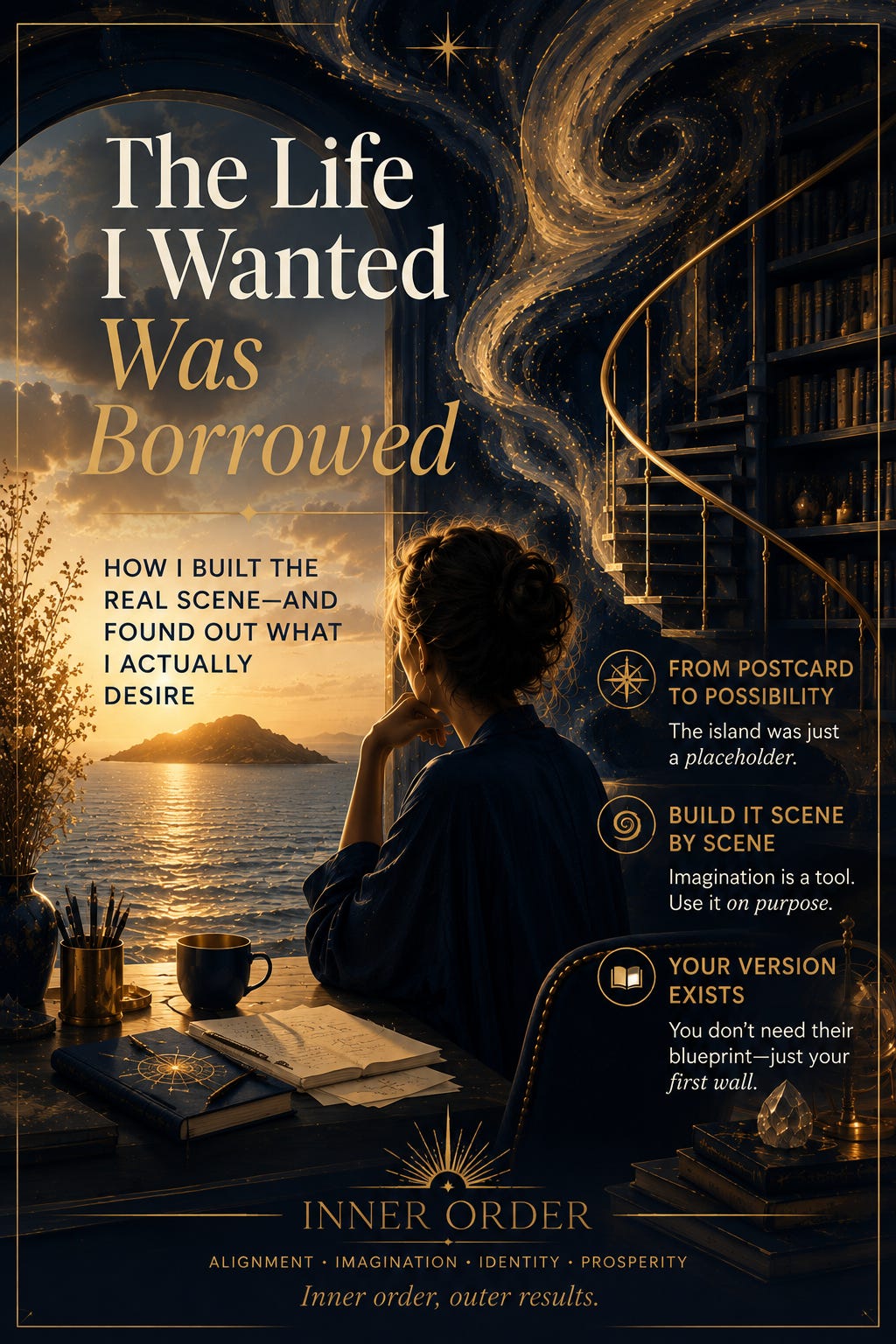
There’s no island in that. No beach, no water, nothing tropical at all, and it should have told me something sooner than it did. I used to think the reason none of it ever built was that I never fully believed the island was mine. I don’t think that’s it anymore. I think I never actually wanted the island. I wanted what I’d assumed it would hand me. No clock. Nobody needing anything from me. Nobody I had to explain myself to. The island was never the desire. It was just the closest picture that seemed to hold all of that, since nobody had ever handed me a better one.
It felt fake for about four sentences, borrowed sentences, the kind you’d see on a poster. Then it stopped being general. It started being that particular quiet, that particular hour, and something in my chest believed it before my head caught up. That’s the part Neville was actually pointing at, more than the island ever could. The detail alone didn’t do it. It was what got me to the feeling of it being already true, and the feeling was the part that did something. Believing hard enough was never the instruction. Feeling it as already so was.
I know how that reads. Like a poster sentence, the kind I said I didn’t want. The difference is I built this one. I didn’t take it off the shelf.
How to Know What you Actually Want
You probably have one too. A picture that’s been handed back to you so many times it started sounding like a fact about you. Maybe it’s not an island. Maybe it’s the corner office, or the beach town, or the person who finally gets it, or the body you had at twenty-four. Whatever shape it comes in, it might not be fully yours either. That’s alright. You already know half of it. You know exactly what you’re living right now that isn’t it. That refusal is real, and it’s more useful than the picture everyone keeps handing you.
I’ve been wondering if that’s actually a decent test for this. Skip the postcard and try the ordinary morning instead. What’s actually in the room, who isn’t there, what you’re not explaining to anyone. If it holds up once you get specific, it’s probably yours. If it goes soft the second you look closely, it probably never was.
A Library Shows up Instead
I don’t have the whole picture. I’d rather say that plainly than hand you one I don’t have yet. But there’s a room in it I can actually see, with total certainty, no guessing involved. A library, with a spiral staircase. I know what’s on the shelves too. The books that actually built me. Beautiful fiction I’ve loved for years. And somewhere in there, one with my own name on the spine. I know the staircase. I know I climb it.
I used to think clarity meant knowing the whole life before imagination was even allowed to start. The house, the location, the schedule, the income, the entire architecture, laid out before I’d earned the right to want any of it. Maybe it only means this much. One thing that’s unmistakably mine. Then the next one. Then the one after that.
Here’s what’s new. I can see what I’m doing there too, not just where I am. I want to help people. Not for hours and hours, not on camera, not by repeating the same story to a new room every week. A few real hours a month, worth $10k or more, because the value was never supposed to live in how much time I gave away. It was supposed to live in what happened inside the room. That’s the opposite of the old template. That one says show up everywhere, all the time, and be endlessly available. This says the fewer hours, the better, as long as they’re the right ones.
That’s smaller than an island and stranger than a course. The first wall I’ve actually framed myself, and I like knowing there’s a whole room left to furnish.
This really resonated with me. Sometimes clarity starts with knowing what we don’t want, then slowly making space for what truly feels like ours. I love the idea of building the vision from the ordinary details instead of borrowing someone else’s picture.
Loved this so much Adele. I have written about the landscape of my mind being rooms, and one of them being a library, stacked with books that walk you through my life. I love how you unpack the experience through this wandering through how imagination plays a role in our deepest understanding of ourselves.