
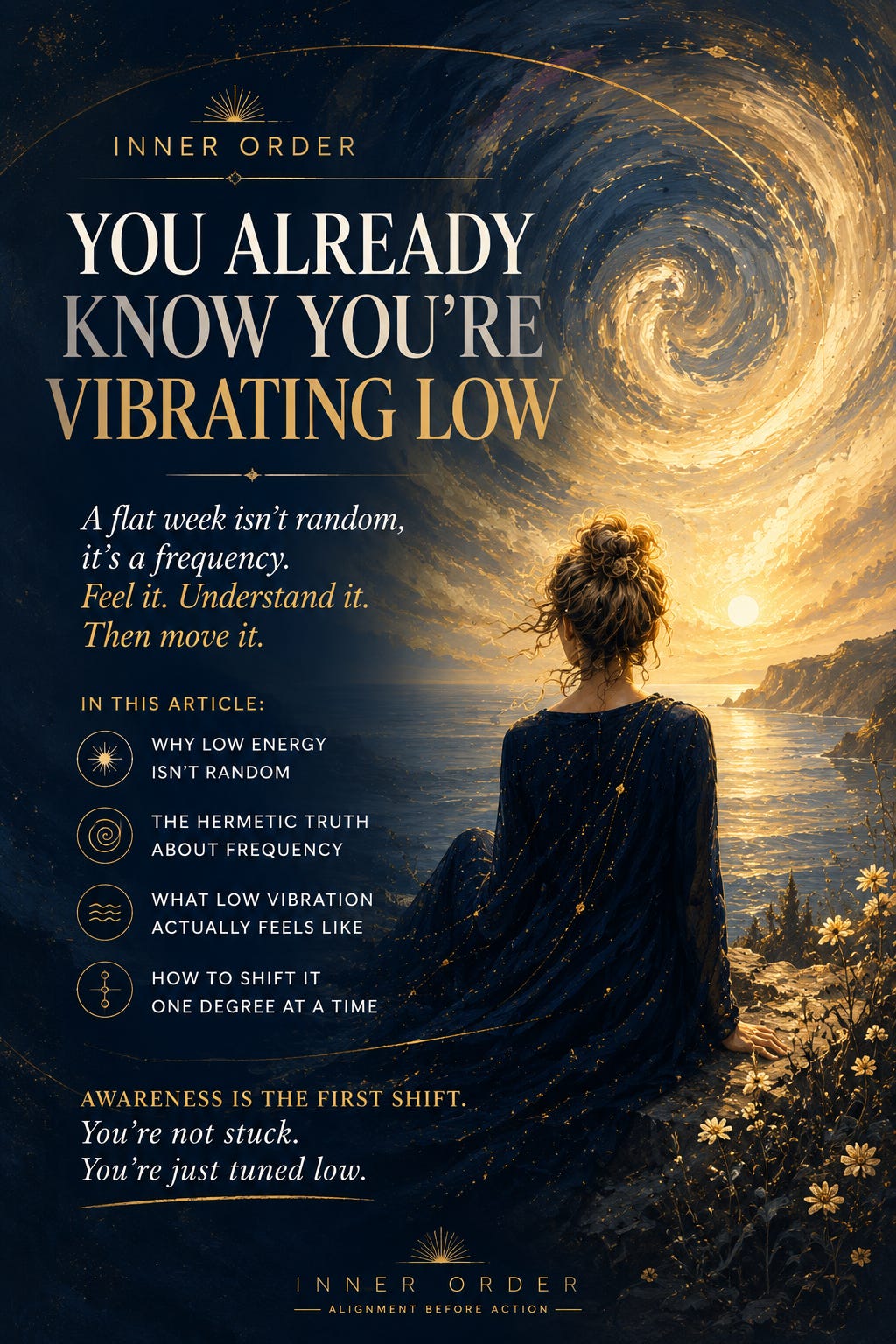
You Already Know You're Vibrating Low
A flat week isn't random, it's a frequency. Once you can feel it, you can start to move it, one degree at a time.

Last week I could feel it. Nothing dramatic happened. I wasn’t in crisis. I sat down most nights and watched something dumb, some show that didn’t ask anything of me, and I noticed I wasn’t inspired by much of anything. I went looking for that love feeling, the pull toward something, the spark that makes you want to create or reach or notice beauty, and it wasn’t there. Not gone exactly. Just quiet. Flat.
I didn’t need a diagnosis for it. I didn’t need a book to tell me something was off. My body already knew. That’s the part that gets me every time I circle back to this: you don’t need the vocabulary to feel the truth of it. You already know when you’re low. You call it a mood, a slump, a blah week. You don’t call it a frequency. But that’s what it is.
Everything Moves
Charles Haanel wrote The Master Key System, the book I’ve read more times than I can count, and his whole system rests on one idea, repeated a hundred different ways across its pages: thought isn’t a separate, private thing happening quietly behind your eyes. Thought is a vibration, moving at a rate, and that rate is what you’re broadcasting into the world whether you mean to or not. The Kybalion, the earlier text on Hermetic law, said it first, and said it plainer. Nothing rests. Everything moves. Everything vibrates. Different words, same floor.
That’s uncomfortable to sit with, because it means the blah week wasn’t only in my head. It was a rate I was holding, and the whole flat, uninspired stretch of that week matched the frequency I was actually vibrating at. Not because I was being punished. Because that’s simply how the law works. Like meets like. It’s the same law underneath the words you speak, which I’ve come to think of as a kind of blade, cutting reality into shape one sentence at a time. Words are vibration you can hear too.

Your Frequency Doesn’t Stay Contained
Here’s the part I didn’t want to admit last week. My flat mood wasn’t only mine to sit with alone. You’ve probably felt this too. Someone walks into a room low, and before a word gets said, the whole room shifts. Vibration isn’t private. Whoever was near me that week, whoever I was texting back, the room itself, was picking up my rate whether either of us meant to or not.
This is the same ground the Russian writer Zeland was standing on with his pendulums, those structures built out of collective attention and emotion that only survive on what people feed them. A pendulum doesn’t care if the charge you’re handing it is love or hate, high or low. It just needs the charge. A flat, joyless week isn’t neutral. It’s still a frequency, and frequency feeds something regardless. Staying low doesn’t just cost me. It’s a signal going out, that something else can lock onto.
High and Low Aren’t Two Things
The Hermetic principle underneath both books is polarity, and it’s the piece that took the edge off the guilt for me last week. High and low aren’t two separate forces fighting each other. They’re the same thing, at different points on one continuous scale. Fear and courage aren’t opposites at war. They’re degrees of the same energy. Which means a low week isn’t a failure state, some broken version of me that needs fixing. It’s just a lower point on a scale I’m always somewhere on. I didn’t fall out of alignment. I moved down the scale a little. That’s a very different thing to sit with than I did this wrong.
And it means the reverse is equally available. If low is only a lower degree on the same scale, awareness is what lets you move up it, one degree at a time.
Not from flat to euphoric in one leap, just from flat to slightly less flat.
Attention is Where the Current Goes
So what shifts it, then. Not gritting my teeth and forcing a better mood. Haanel spends a good part of his book on concentration, and it’s the whole engine of his system: wherever you hold your attention, that’s where you concentrate the current. This is close to what the emotional guidance and alignment work points at too, a strand of this same teaching that treats emotion itself as the measurement: your feelings aren’t random weather, they’re a live readout of exactly where you are on the scale right now. Feeling, in that sense, stops being a side effect and becomes the actual instrument you’re working with. I didn’t need a chart last week to know I was low. Attention, then, isn’t about forcing yourself to a better feeling by will. It’s about reading the instrument you already have, honestly, instead of arguing with it.
The practice itself is smaller than it sounds. You’re not talking yourself into joy from a dead stop. You notice where you are, name it honestly, flat, tired, low, and reach for the next thought that feels one degree better. Not the best one you can imagine. Just the next one up. A flat week doesn’t need a leap to inspired. It needs a string of small reaches, one slightly better thought at a time, until the rate itself has moved.
Meditation, in this sense, isn’t a rest from your day. It’s calibration. You’re not stepping out of the flow. You’re steadying yourself inside it long enough to feel which way it’s moving.
I noticed the shift today before I could explain it. Nothing external changed. I felt a little more room in my chest, a little more pull toward things I care about. I’m not going to tell you I fixed it or figured it out, because I didn’t do anything except notice. I sat with it. I let myself feel the difference between last week’s flat and today’s lift, and that noticing alone did something. Attention landed somewhere, and the current followed it.
The Outpouring
Haanel writes about a universal supply, already moving, already outpouring, whether you’re tuned to receive it or not. I like that more than the effort version of manifestation, the one where you’re supposed to conjure something out of nothing through sheer force of wanting. This isn’t about wanting harder. It’s about where you’re standing on the scale, and whether you’re letting the current move or blocking it without noticing.
I keep coming back to the week behind me, the shows, the flatness, the missing spark, and now I can see it for what it was. A frequency, held long enough to become a mood, spoken into a few flat sentences, picked up by whoever was near enough to catch it. None of that is dramatic. It’s how the law runs, quietly, all the time, whether I’m paying attention or not.
Today feels a little more alive. I’m not calling it fixed. I’m noticing that the room feels different when I walk into it, and that the next thing I say out loud is going to carry whatever I’m actually vibrating at, whether I mean it to or not. That’s the part I can’t unknow now. So I’m watching what I feed. And I’m watching what I say.
You already know your own version of this. The week that felt like nothing. The room that felt different the second you walked into it. The word you almost said out loud, and swallowed instead. You’ve been reading your own frequency this whole time. You just didn’t have the word for it yet.
This is the real work Inner Order was built for. Not another mood-management trick, but five months of practice reading your own frequency honestly and moving it up one degree at a time, on purpose, until it stops being accidental. Come study with me.
Adele
One idea that changed how I think about "low vibration" is this:
You don't have to believe in the word vibration to recognize the experience.
You already know when your attention narrows, when your words get heavier, when beauty stops catching your eye, or when everything starts feeling like effort.
Whether you call it mood, state, nervous system, or frequency, the first step isn't fixing it.
It's noticing it.
Awareness is often the beginning of the shift.
100%, Adele! I was just talking with someone earlier today about the Map of Consciousness by Dr. David R. Hawkins, and isn't it interesting that I came across your writing? Coincidence, maybe. Similar frequency bandwidth, definitely. Thanks, Adele, for making a challenging concept to grasp understandable in everyday language.