
I Read About Inner Work for a Decade. I Was Very Informed and Completely Stuck.
The gap between knowing the teaching and living it is real. This is what finally closed it.

There is a version of finding consciousness work that looks like a clear before and after. One book, one moment, one thing that lands and changes everything. That is not my story. I want to tell you about the gap, because closing it is the only thing that actually changes anything.
My story is longer and messier and involves a lot of years of understanding ideas I had not yet figured out how to live.
I want to tell you about it, because I think the messy version is more useful than the clean one. And because the reason I built what I built, the reason Inner Order exists in the form it does, comes directly from the gap between understanding and doing that I spent a long time sitting in.

The First Book
I do not remember the exact circumstances of finding the first book. I remember the feeling of reading it, which was something between recognition and discomfort, the particular quality of landing on an idea that makes you realize you have always, somewhere underneath, known it was true.
The idea was simple. The inner life is the cause. The outer life is the effect. Not as a spiritual position to adopt. As a structural fact about how experience is generated.
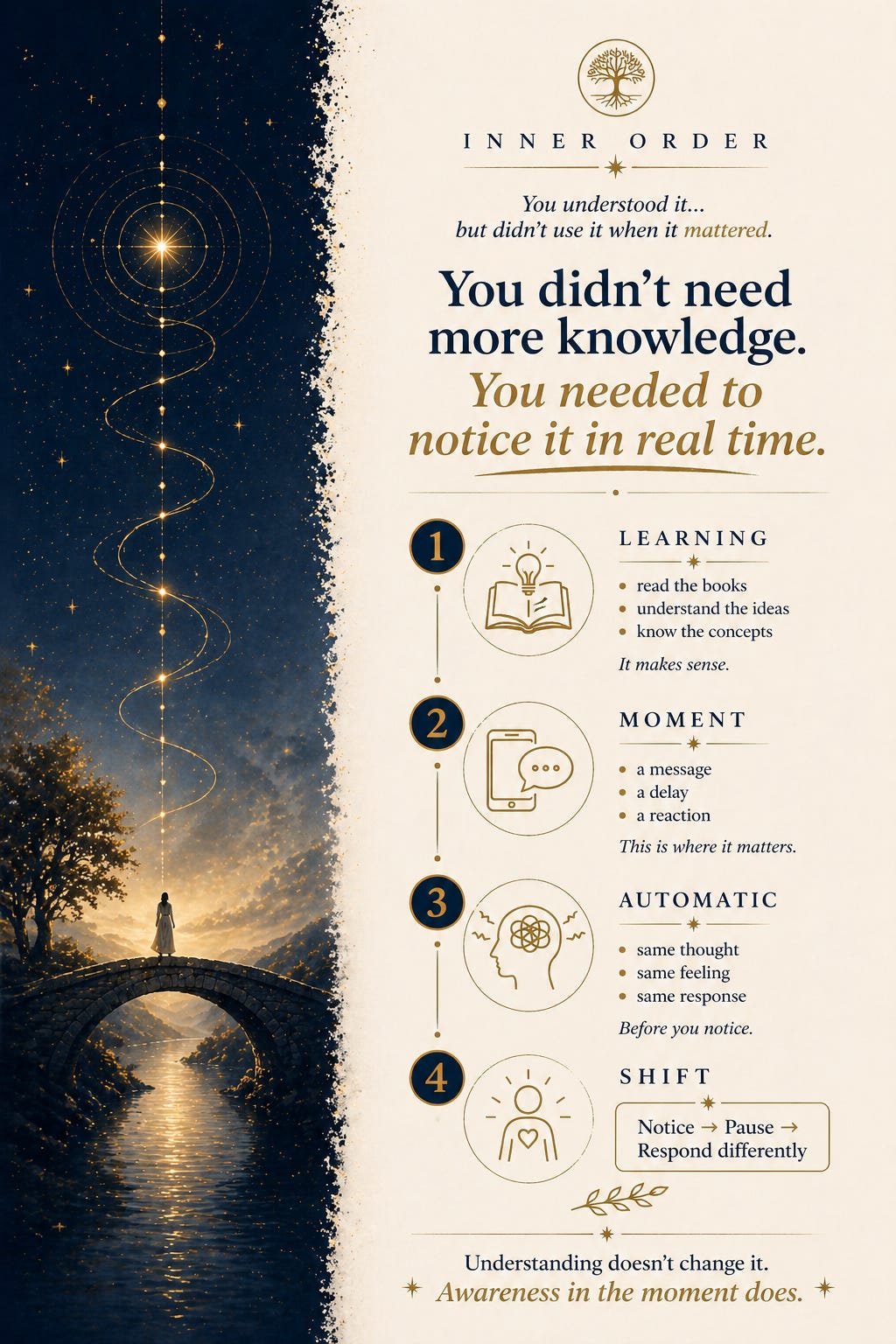
I read it several times. I highlighted it. I believed it, at the level of intellectual agreement, immediately and completely. And then I went back to my life and continued operating as though the outer circumstances were the cause and my inner state was the reaction.
Because believing something and living from it are not the same thing.
And I had not yet understood the difference.
I wrote about why that difference matters, and what the mechanism underneath it actually is in my first article Inner Order: The Missing Foundation.
When Understanding Doesn’t Change Anything
What followed was a period I now recognize as both necessary and frustrating. I read widely. I found more books. I found the teachers whose ideas, in different forms and from different angles, all pointed toward the same understanding: consciousness is primary. The inner world is generative. What you hold in the deeper layers of thought and belief is not describing your life, it is creating it.
I found Neville Goddard and his precise, uncompromising insistence that the inner state is always and only the cause. If you have not read the series I wrote on his work, it is a good place to start.

I also found Thomas Troward and his architectural rendering of how the subjective mind executes whatever the objective mind directs. I found teachers who, in different language, pointed to the same structure.
That the inner state precedes the outer result.
That the mind carries instructions long before we consciously choose them. That self-concept quietly organizes what we notice, what we attempt, and what we believe is possible.
I understood all of it. Genuinely. I could explain the ideas clearly. I could see where they applied in my own life. And still, something underneath had not moved.
I had built an impressive intellectual relationship with ideas I had not yet let into the parts of me that needed them most.
A lot of people in this space believe that reading more, understanding more deeply, finding the right teacher, will eventually close the gap. It will not. The gap closes through practice, not through understanding. That distinction took me an embarrassingly long time to see clearly.
The Beliefs Underneath the Ideas
What shifted was not a new idea. It was a question I finally asked honestly enough to sit with properly.
What do I actually believe? Not what do I intellectually agree with. Not what do I aspire to believe. What do I actually, functionally, in the moments when I am not performing or hoping or reaching, believe is true about who I am and what is available to me?
The answer was considerably more limited than my reading list suggested it should be.
I believed I had to earn everything. I believed ease was suspect. I believed that the version of the work I was doing was almost what it could be, but not quite, and that the not-quite was somehow appropriate. I believed, underneath a decade of reading about the self-concept, that mine was basically fixed. Those beliefs, the ones about worth, about ease, about what is almost available but not quite, are what I wrote about in this piece: The File you Never Updated.
None of those beliefs had been chosen. All of them had been inherited, absorbed, concluded from specific experiences in specific contexts that were long gone. And all of them had been quietly running my inner life while I read about inner life with genuine interest.
Why Inner Order Exists
I built Inner Order because of that gap. Between understanding the teaching and having a practice that actually works on the places the teaching is pointing at.
The books gave me the ideas. What I needed, and what I eventually built for myself and then structured into a curriculum, was a way to work with those ideas at the level where they actually live. Not the level of intellectual agreement. The level of the perception loop running before I finish reading an email. This is the same mechanism I describe in the attention pattern that quietly creates outcomes before we realize we are participating.
The level of the belief about worth that determines what I ask for and what I quietly talk myself out of. The level of the self-concept that has been filing evidence about who I am since long before I was paying attention.
That is what a five-month practice curriculum can do that a book cannot. Not because the curriculum contains better ideas. Because it creates a structured, weekly, accompanied encounter with the places inside where the ideas need to go.
Understanding this work is not the same as doing it. I know that distinction from the inside. It is the distinction Inner Order was built to close.
If you are somewhere in the middle of that gap, reading and recognising and not yet quite living it, you are in exactly the right place to start. The I AM guide is the most direct entry point into the practice side of this work. Five days of finding the statements running your self-concept without your awareness and beginningto revise them.
Three questions worth sitting with before you close this tab:
What do I intellectually agree with that I am not yet living from?
What would change in the next 24 hours if I actually believed it?
What is one specific place where the belief and the behaviour do not match?
You do not need to answer all three. Just the one that lands with a slight discomfort.
That is the one pointing at something real.
If you want to go deeper into the full architecture, Inner Order is the five-month curriculum built specifically to close the gap. It opens in May at prosperwithadele.substack.com. Subscribe for early access.
Before you go I'd love to hear from you:
What is the idea you have understood for years and still have not quite managed to live? The one you could explain clearly to someone else but that something underneath still resists. I would genuinely like to know. Drop it in the comments.
If someone you know is caught in the same gap, understanding without living, this piece is worth sharing. Restack or send it directly.
Share this article on Pinterest:
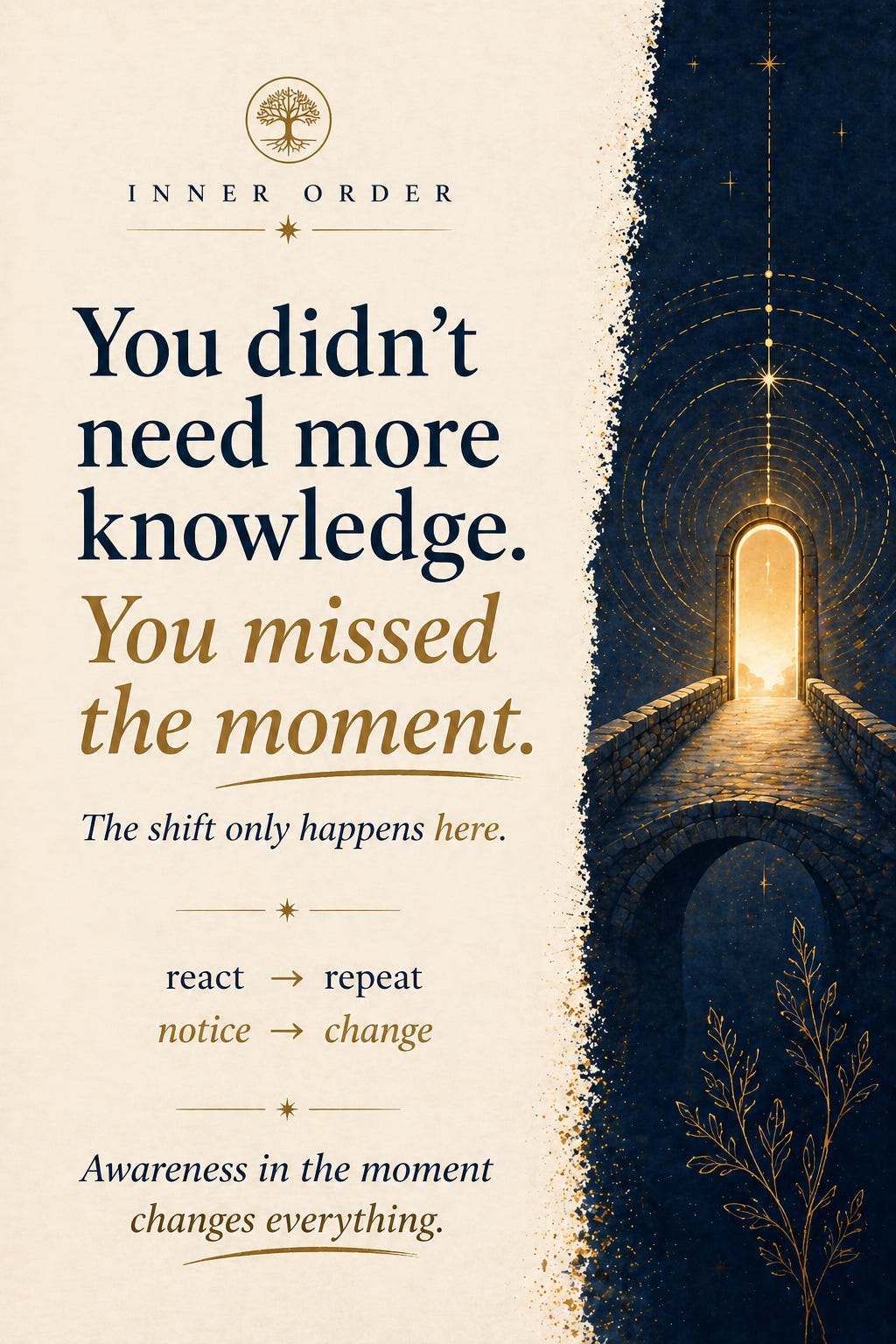
A lot of us didn’t struggle because we lacked information.
We struggled because information lives in the intellect, and life is being lived from something deeper.
You can understand an idea and still be operating from an unchanged structure underneath it.
Inner work begins when the layer producing your thoughts starts to change, not just the thoughts themselves.
That's when understanding starts becoming experience.
"Because believing something and living from it are not the same thing." I was guilty of pretending that increasing my knowledge base was synonymous with changing my life for a long time too. Still am sometimes!